By T.S. Akers
The Muskogee Masonic Temple of 1925.
The city of Muskogee traces its beginnings to the late 1820s
with the establishment of the Creek Agency. After flooding in the Three Forks
area damaged the agency building in 1833, the agency moved slightly to the
west, though it remained north of the Arkansas River. Further flooding in 1852
led to the agency being moved south of the Arkansas River at the base of Fern
Mountain.[1]
It was here that Muscogee Lodge No. 93 was chartered in 1855, ushering the
arrival of Freemasonry into the community.[2]
The community that developed around the Creek Agency at this time included
stores, a boarding house, a district courthouse, a church, and a school. Whilst
most fled the Creek Agency during the Civil War, the community survived the
hostilities, and many returned after the conflict.[3]
When the Missouri, Kansas, & Texas Railroad (the Katy) crossed the Indian
Territory along the Texas Road in 1872, they constructed a depot at the top of
the grade, giving birth to the city of Muskogee. The several agencies of the
Five Tribes were consolidated in 1874, becoming the Union Agency with its
office constructed west of the Katy Depot on a site that came to be called
Agency Hill.[4]
The old Creek Agency as a community was abandoned and the city of Muskogee
began to flourish, becoming known as “The Queen City of the Southwest.”[5]
Freemasonry also thrived in Muskogee, a city that had a strong possibility of
becoming the capital of the State of Sequoyah. To accommodate the Masonic
Fraternity in Muskogee a temple worthy of the city’s stature was ultimately
brought forth.

The Thomas F. Meagher Map of the Old Creek Creek Agency, c. 1938.
(Courtesy of the Oklahoma Historical Society)
The original lodge established at the Creek Agency in 1855,
Muscogee Lodge No. 93, which was chartered by the Grand Lodge of Arkansas, did
not return to the agency after the Civil War. Those Brethren, under the
direction of lodge member George W. Stidham, resumed their Masonic pursuits at
Eufaula.[6]
Not far from Muskogee, at Fort Gibson, Alpha Lodge No. 122 had been chartered
by the Grand Lodge of Kansas in 1872. That lodge’s original Worshipful Master
was Patrick J. Byrne and it was from Alpha Lodge that Freemasonry came to the
city of Muskogee.[7]
Byrne was the third Grand Master of Masons of the Indian Territory and eventually
made his residence in Muskogee.[8]
When Muskogee Lodge No. 28 was chartered in 1888, Byrne served as the first
Worshipful Master.[9]
Byrne also went on to become the first Mayor of Muskogee after the city’s
incorporation in 1898.[10]
Additional Masonic orders followed the establishment of a Craft Lodge in
Muskogee. There was Muskogee Chapter No. 3, Royal Arch Masons, chartered in
1890 and Muskogee Commandery No. 1, Knights Templar, chartered in 1892. Both
orders were first led by Robert W. Hill, who was also the first man appointed
as deputy for the Scottish Rite in the Indian Territory. Hill had grand plans
of establishing Scottish Rite bodies in Muskogee but was unable to make that
materialize.[11] A
Council of Royal and Select Masters, Muskogee Council No. 2, was chartered in
the city in 1894.[12]
Like in many young cities, the Masonic orders of Muskogee
borrowed space for a period. Meetings were first held in the Severs Block
(owned by Bro. Frederick B. Severs), but permanent space was secured on the
second floor of the Turner Hardware Building in 1894 (owned by Bro. Clarence W.
Turner).[13]
This entire structure, like much of downtown Muskogee, was lost during The
Great Fire of 1899.[14]
From there, the Masonic orders had two temporary homes. The first was in the
quarters of the Women’s Christian Temperance Union and the second was with the
Knights of Pythias. Permanent accommodation was secured by the Masons in 1900
on the third floor of a new building being financed by Clarence W. Turner,
Napoleon B. Moore, and Pleasant Porter; all members of Muskogee Lodge No. 28.
That building, which was located at the northwest corner of Second and Broadway
Streets, became the home of the First National Bank in 1911. The bank had
purchased the lower two floors, whilst the Masons owned the top floor outright.[15]
The Masonic fraternity was growing exponentially across
Oklahoma in the first part of the twentieth century and Muskogee was no
exception, adding the Bedouin Shrine Temple to the landscape in 1911.[16]
There were just 89 members of Muskogee Lodge No. 28 in 1900.[17]
By 1915 that number had grown to 295 Masons and another 105 in Oriental Lodge
No. 430, which had been chartered in Muskogee in 1912.[18]
Growing pains were likely becoming evident in the quarters occupied by
Muskogee’s Masonic orders and in 1915 Muskogee Chapter No. 3, Royal Arch Masons
stepped forward to bear the expenses of forming a Temple or Masonic Building
Association. The Great War placed any plans for a new building on hold, but the
effort was resumed in 1919.[19]
It was announced in October of 1922 that the Masonic Building Association was
in favor of constructing a new building to house all the Masonic orders of
Muskogee, except the Bedouin Shrine Temple, at an estimated cost of $250,000.
The association’s discussion called for meeting rooms for the various Masonic
orders (which now included a third lodge, Trinity Lodge No. 502) and an
auditorium for both Masonic and public use.[20]
The proposed site, which the Masons had acquired, was at the corner of South
Sixth and Boston Streets. This was directly north of the Bedouin Shrine Temple
on property where Muscogee Principal Chief Pleasant Porter’s home was
previously located.[21]

Postcard featuring an architectural rendering for the Muskogee Masonic Temple by Bassham and Howenstine and Hicks.
With the plans announced and land acquired for a new temple
came the business of financing it. The Masonic Building Association adopted the
subscription method to raise the necessary funds for the new Muskogee temple.
At a widely attended meeting in February of 1923, a total of $70,000 was
pledged towards the building fund. The Bedouin Shrine Temple was not asked to
contribute, but they did provide $1,000 in support. With the amount of funds
pledged, building chairman William F. Moffatt recommended that construction
commence, but not to exceed a figure of $200,000.[22]
The Muskogee architectural firm of Bassham and Howenstine was engaged in 1924,
with Jewell Hicks of Oklahoma City as associate architect, to return designs
for the new temple, which were presented and accepted in December of that year.
The building was noted to have construction costs of $150,000 at that time,
exclusive of furnishings and fixtures; the proposed site itself was valued at
$25,000.[23]
Construction of the temple was contracted to the Dougherty-Nichols-Wilson
Construction Company and began in the spring of 1925. Contractor Ben Dougherty noted
that 186 train carloads of material would go into the new temple.[24]
The cornerstone for the building was laid on the 7th of May in 1925 with
members of all the Masonic orders of Muskogee present to witness the occasion.[25]
Working with a seventy-five-man crew, the builder estimated in September that
the temple would be completed in December, excluding interior finishings. Quite
the fete, this completion date was three months ahead of schedule.[26]

The cornerstone ceremony for the Muskogee Masonic Temple, held on the 7th of May, 1925. The Bedouin Shrine Temple can be seen in the background.
(Courtesy of Muskogee Lodge No. 28)
In what today would be called a “soft opening,” the first
event to be held in the new Muskogee Masonic Temple was the installation of
officers for the three Craft lodges. Held on the 26th of December in 1925, the
installation ceremonies were conducted by Henry S. Johnston, Past Grand Master.[27]
The temple designed by Bassham and Howenstine and Hicks is Classical Revival in
style and, after all considerations, cost between $250,000 and $280,000 to
erect.[28]
The building, which fronts South Sixth Street, is of reinforced concrete, clad
in Bedford limestone. The eastern elevation includes a flight of steps leading
up to the portico, which features a colonnade of eight Doric columns,
supporting an entablature. Entry to the mezzanine level lobby is gained through
three steel doors. The side wings of the temple are plain, with each decorated
only with a shallow, unglazed window niche. The other public entrance to the
temple is along the southern elevation on Boston Street. This elevation
includes glazed windows along the eastern portion of the mezzanine level and
unglazed window niches along the western portion, behind which is a windowless
lodge room. There is a central entrance with steps leading up to the mezzanine
level and a lower entrance to the basement dining room and kitchen, which is
lined with windows. The western elevation features service entrances and the
northern elevation, originally concealed by another building, is devoid of
ornamentation.[29]
The public really got its first glimpse of the interior of
the new Muskogee Masonic Temple in February of 1926. The interior remained
devoid of its furnishings at this point though, which were estimated to cost an
additional $35,000. The windowless structure, which was likened to a tomb, was
still being lit with temporary construction fixtures.[30]
The occasion for the February opening was the annual carnival dance of the
Bedouin Shrine Temple’s Drum Corps, with performances by the Gillespey
Orchestra. A special feature of the affair was novelty “radio dancing,” in
which attendees danced whilst listening to music via headphones.[31]
The dancing was conducted in the temple’s basement dining room, which doubled
as a ballroom, capable of accommodating between three to five hundred people.
Following the dance, the Muskogee Daily Phoenix’s headline of the 21st
of February read “Masons Unofficially Accept New Temple.” The full page spread,
which included photos of the building’s interior highlighted how Muskogee’s
Masonic leaders had inspected the temple and accepted the work from the builder.[32]
In addition to the three lodges and the three separate entities that comprised
the Muskogee York Rite Bodies, the temple’s coming residents included two
chapters of the Order of the Eastern Star and Mt. Olivet Shrine No. 1 of the
White Shrine of Jerusalem; along with the Order of Rainbow for girls and
DeMolay for boys.[33]

Some of the first photos of the Muskogee Masonic Temple's interior, as they appeared in the
Muskogee Daily Phoenix in 1926.
Even without furnishings, the Masonic orders of Muskogee set
to using their new temple. The White Shrine of Jerusalem conducted a benefit
bridge tournament in late February of 1926, planning for 100 tables to be set
up in the temple’s dining room. The proceeds raised were to be applied to the
sum the White Shrine had pledged to the building fund.[34]
This was followed by an open house for Muskogee Masons and their families on
Sunday, the 21st of March.[35]
Entering the new temple that day by way of the main entrance on South Sixth
Street, attendees first encountered the mezzanine lobby. This space features a
red and white checkered tile floor, wainscoting of Carthage marble, and is
illuminated by Art Deco chandeliers. For public events in the auditorium, there
is also a ticket booth in the lobby. From the south end of the lobby, the
secretarial offices can be accessed. Additionally, a hall leading from the
south end of the lobby first arrives at the lounge, which features a polished
oak floor, fireplace, and built-in bookcases. [36]
The hall proceeds around the lounge to the Boston Street entrance to the
building and the south lodge room utilized by the Craft lodges. From the north
end of the lobby, a hall wraps around providing access to two other lodge
rooms: one for the Eastern Star and White Shrine, the other for the York Rite.
The lodge room occupied by the York Rite, situated in the northwest corner of
the temple, features an arched ceiling and Tudor style arched doors.[37]
These medieval elements were common features of meeting rooms used by
Commanderies of Knights Templar. Additionally, a stairwell leads down from the
York Rite room to the armory in the basement used to house the paraphernalia of
those Masonic orders.[38]
Each of the three lodge rooms boast ceilings nineteen feet in height and
include baclonettes from which projection equipment could be operated for
Masonic ceremonies.[39]
The lobby also provides access to the basement where, in addition to the dining
room, a room was located for use by the youth orders.
Continuing to set the stage for public use of the building,
the Muskogee Firemen’s Benefit was also held in the new Masonic temple in March
of 1926.[40]
This was followed by an annual dance hosted by the Order of DeMolay in June,
which they hoped to make the largest yet.[41]
With the interior furnishings complete, the time to welcome the public at large
came on the 27th of August. Guides were on hand to escort visitors across the
building as the doors were opened at 7:30 in the evening. For fifty cents,
attendees could attend a party in the rooftop garden hosted by the Bedouin
Shrine Temple styled “A Night in the Orient.”[42]
It was reported that one thousand guests attended the public opening and whilst
many would have found the lodge rooms curious, the temple’s auditorium and
rooftop garden were undoubtedly the main attractions.[43]
As noted earlier, the temple’s mezzanine lobby included a ticket booth for
public events. It is from that lobby that access was gained to the auditorium
by way of double doors on either side of the ticket booth and stairwells
leading up to the balcony flanked those entry doors. The auditorium, which
slopes downward toward the stage, is capable of seating 1,200.[44]
The stage itself is noted to be 34 by 30 feet and the proscenium arch extends
its entire width. Because the building is of reinforced concrete, the balcony
included, it was able to be constructed without supporting pillars that might
obstruct views.[45] At
the time of its construction, the Muskogee Masonic Temple's auditorium was
noted as being the second largest in the city and the Masons already had their
eyes on hosting future conventions and statewide Masonic gatherings in it. The
auditorium also featured a projection booth for screening films, though it was
stressed that the temple would not be a “picture house.”[46]
Literally crowning the temple’s public space was the rooftop garden; which
featured promenade tile and 6,500 square feet of space running along the
eastern and southern portions of the building.[47]
To accommodate catering needs, a dumbwaiter ran from the basement kitchen to
the rooftop.[48]
Adding to the appeal of the temple was its air ventilation system, which was
said to be ultra-modern.[49]
Referred to as an “air washer,” units housed in the basement forced air into
the lodge rooms and auditorium.[50]
The system led the Masons to boast of their new temple as being “the coolest
place in Muskogee.”[51]

The Grand Commandery Knights Templar of Oklahoma assembled at Muskogee in 1930 for its
35th Annual Conclave.
(Courtesy of the Grand Commandery of Oklahoma)
The Muskogee Masonic Temple entered an active period of
public use soon after its August opening. The building played host to the
coronation of the Queen of the Eastern Oklahoma Playground Association in
January of 1927.[52]
The Association was developed to promote Eastern Oklahoma, and its lakes, as a
tourist destination.[53]
The coronation of Queen Norma Smallwood was to be a grand affair, calling for a
sixty-five-person court of knights, pages, and ladies in waiting.[54]
The annual communication of the Grand Lodge of the State of Oklahoma was hosted
in the temple that February, with approximately 1,500 Masons in attendance.[55]
April saw a visit from the traveling lecturer David Goldstein at the temple,
sponsored by the Knights of Columbus, who spoke on “Red Mexico” and the threat
of bolshevism.[56]
In 1928 the temple was the site of a special showcase of Muskogee’s pets. That
February the Muskogee Daily Phoenix and Times-Democrat hosted the “Alley
Cat and Mongrel Dog Show” for animals lacking pedigrees.[57]
A traveling marionette show stopped at the temple in March with a production
titled The Blue Bird.[58]
Muskogee’s Little Theater Guild presented the English comedy Lillies of the
Field, a three-act play, at the temple in November of 1929.[59]
This was followed by a bizarre event in December presented by Rev. Carle D.
Boynton, D.D. from Kansas City. Using audio equipment, Boynton intended to
illustrate to intelligent, clear-thinking citizens that “spirit voices” were
capable of speaking “as they did to the prophets of old.” Boynton welcomed all
to witness his “audible demonstration of truth.”[60]
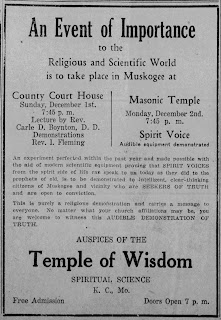
The December of 1929 advertisement for Rev. Boynton's Spirit Voice,
demonstrated by Rev. Fleming.
The economy began to shift late in the summer of 1929 with
the stock market crashing that October. The economic downturn that turned into
the Great Depression certainly had an impact on Freemasonry. The year 1929
ended with there being a total of 1,759 Masons on the books across the three
lodges in Muskogee, granted some of those men could have belonged to more than
one lodge.[61]
By 1939 that number had declined to 1,204 Masons.[62]
The membership decline in Muskogee Lodge No. 28 was the most severe, with a 39%
decrease. There were two factors that seemed to save the Muskogee Masonic
Temple from the same fate as that of the Oklahoma City Masonic Temple. The
first was that the building was not heavily mortgaged, with most of the
construction costs being paid for with money raised by the membership. It was
noted in 1933 that the Masonic Building Association had a remaining
indebtedness totaling $30,500.[63]
The second factor that seems to have kept the building open was its continued
use. The Tipica Orchestra of Mexico stopped at the temple in January of 1930.
With two performances only, tickets were priced at $.25 for children at the
matinee and $1.00 for adults at both shows.[64]
A Passion Play performance by a German touring company was held at the temple
in March of 1933, though the production was in English.[65]
Whilst public use of the building typically involved entertainment, the tone
was far more solemn in December of 1934 when services for Officer Romie H.
Hinson were held there. Hinson was a Muskogee police officer, and Mason, who
was killed in the line of duty responding to an argument that erupted following
a traffic incident.[66]
Interestingly enough, there is no mention locally of any relief efforts for the
Great Depression being held at the Muskogee Masonic Temple.
As the Second World War set in, the 1940s did see the
Muskogee Masonic Temple host activities for the war effort. The temple served
as a production center for the Red Cross where comfort kits and sewing kits
were assembled for servicemen. The comfort kits included things such as shaving
items, tobacco, and games. Additionally, volunteers knitted sweaters and jeep
caps at the temple.[67]
During the 88th Infantry Division’s short stay at nearby Camp Gruber for
training in 1943, a luncheon was held monthly for the officers’ wives in the
temple dining room.[68]
The Veterans of Foreign Wars held a party for servicemen at the temple in July
of 1944.[69]
And when the war led to a heating gas shortage in Muskogee during the winter of
1943, all Masonic meetings at the temple were cancelled.[70]
Other events for entertainment also continued at the temple through the 1940s.
The famous big game hunter and animal collector Frank Buck spoke at the temple
in January of 1943. Noted for bringing over 100,000 live specimens back to the
United States, including a king cobra for the Bronx Zoo, Buck’s presentation
included a film of his travels.[71]
The following month, the Trapp Family Choir visited the temple for a concert;
that is the Baron Georg von Trapp family on whom the musical The Sound of
Music was based.[72]
The singer Maria Gambarelli of New York’s Metropolitan Opera also performed at
the temple in 1943.[73]
The 1950s marked a renewal in Masonic membership in Oklahoma
and Muskogee certainly benefited from this. By the end of the decade, there
were 2,637 Masons in Muskogee with 1,243 of them in Oriental Lodge alone.[74]
It was in the following decade that Masonic decline set in with the total
number of Masons in Muskogee slipping to 2,155 by 1969, an 18% decrease.[75]
The Muskogee Masonic Temple continued to enjoy Masonic use, but the 1950s saw
some of the final instances of public use for the building. In what may have
been the final performance held in the auditorium, the temple hosted a return
of prima ballerina Marina Svetlova in February of 1950. Svetlova, part of the
company of the Metropolitan Opera of New York, was touring with Robert Roland
of the Ballet Russe.[76]
Perhaps what was one of the last non-Masonic assemblies in the temple was the
annual Rougher Banquet, held by the Jaycees in January of 1954. The mascot of
Muskogee High School is the Roughers, which is a representation of an oil
roughneck. The guest speaker at the banquet that evening was University of
Oklahoma football coach Bud Wilkinson, who had won a National Championship with
his team in 1950.[77]
In the years to come, the temple’s auditorium mostly sat vacant; rendered
nearly unusable by a combination of factors. The original stage fittings were
never replaced as the building aged, the original narrow theatre seats
remained, and modern air conditioning was never installed in the auditorium.
The Muskogee Masonic Temple survives as a Masonic meeting
hall today largely through its continued use by the Masons of Muskogee. Whilst
some of the temple’s features, such as the rooftop garden, are distant
memories, much of the building remains as usable today as it was in the 1920s.
The temple was added to the National Register of Historic Places in 2014, an
effort which the membership assisted with in preparing the nomination.[78]
Such listings with the National Register of Historic Places not only provide a
permanent record of the given location but help to protect those locations for
the future. Today the temple is undergoing modest preservation efforts led by the
Masonic bodies of Muskogee and the building stands as a testament to the golden
age of American fraternalism, the period during which it was constructed. Though
the sun may have set on Muskogee's moniker as "The Queen City of the
Southwest," the Masonic temple that was brought forth is certainly one
that represents the city's former stature well.

A 1934 postcard view of the realized Muskogee Masonic Temple.
[1] Jonita Mullins, "Creek Agency had
several locations," Muskogee Phoenix (Muskogee, OK), September 26,
2015.
[2] Charles E. Creager, History of Freemasonry
in Oklahoma (Muskogee, Oklahoma:
Muskogee Print Shop, 1935), 28.
[3] Mullins, "Creek Agency had several
locations.”
[4] Wallace F. Waits, Jr., "Muskogee," The
Encyclopedia of Oklahoma History and Culture, accessed December 21, 2023, https://www.okhistory.org/publications/enc/entry.php?entry=MU018.
[5] C.W. West, Muscogee, I.T.: The Queen City
of the Southwest (Muskogee, Oklahoma: Muscogee Publishing Co., 1972), 88.
[6] “Eufaula Masonic Lodge: Oldest in Oklahoma,” The Indian Journal
(Eufaula, OK), March 2, 1922, 3.
[7] Masonic Centennial Lodges: 1874-1974
ed. Marvin L. Julian (Guthrie: Oklahoma Lodge of Research, 1974), 13.
[8] West, Muscogee, I.T.: The Queen City of
the Southwest, 137.
[9] Masonic Centennial Lodges: 1874-1974,
25.
[10] West, Muscogee, I.T.: The Queen City of
the Southwest, 137.
[11] Robert G. Davis, The Honored Men of
Oklahoma Scottish Rite Masonry (Oklahoma: Oklahoma Lodge of Research,
1997), 17-18.
[12] John D. Benedict, Muskogee and
Northeastern Oklahoma (Chicago: S.J. Clarke Pub. Co., 1922), 1: 430-436.
[13] Mark McFadden, "History of Muskogee's
Masonic Temples" (presentation, Oklahoma Lodge of Research, Muskogee, OK,
March 31, 2018).
[14] West, Muscogee, I.T.: The Queen City of
the Southwest, 59.
[15] McFadden, "History of Muskogee's Masonic
Temples.”
[16] Benedict, Muskogee and Northeastern
Oklahoma, 1: 430-436.
[17] Proceedings of the M.: W.: Grand Lodge
A.F. & A.M. of the Indian Territory: Twenty-Seventh Annual Communication
(Wagoner, Muscogee Nation: 1900), 129.
[18] Proceedings of the M.: W.: Grand Lodge
A.F. & A.M. of the State of Oklahoma: Seventh Annual Communication
(Guthrie, OK, 1915), 69-75.
[19] McFadden, "History of Muskogee's Masonic
Temples.”
[20] "New Masonic Temple?," Muskogee
Daily Phoenix (Muskogee, OK), October 22, 1922, 1.
[21] "Muskogee's New Quarter of a Million
Dollar Masonic Temple," Muskogee Daily News (Muskogee, OK), October
4, 1925, 1.
[22] "$70,000 Subscribed to Masonic
Temple," Muskogee Times-Democrat (Muskogee, OK), February 14, 1923,
9.
[23] "Masons Select Design for Temple That
Will Cost Quarter Million," Muskogee Times-Democrat (Muskogee,
Oklahoma), December 19, 1923, 1.
[24] "New Masonic Temple," Nowata
Daily Star (Nowata, OK), March 16, 1925, 6.
[25] Robert T. Shipe, Cornerstones by Grand
Lodges, A.F. & A.M. in Oklahoma: 1875-2015 (Guthrie, OK: Grand Lodge of
Oklahoma, 2016), 408.
[26] "Temple Done Long Before Its
Schedule," Muskogee Daily News (Muskogee, OK), September 23, 1925,
3.
[27] "Masons Hold Ceremony at New
Temple," Muskogee Daily News (Muskogee, OK), December 20, 1925, 1.
[28] "Open Masonic Temple to Public
Tomorrow," Muskogee Daily Phoenix (Muskogee, OK) August 26, 1926,
5.
[29] Dianna Everett, National Register of Historic
Places Nomination Form, Muskogee Masonic Temple, NRIS No. 14000053, July 2013,
Section 7, nr2_shpo.okstate.edu/pdfs/14000053.pdf.
[30] "Masons Unofficially Accept New
Temple," Muskogee Daily Phoenix (Muskogee, OK), February 21, 1926,
3B.
[31] "Radio Dance to Open New Masonic
Temple," Muskogee Daily News (Muskogee, OK), February 8, 1926, 12.
[32] "Masons Unofficially Accept New Temple.”
[33] "Organization Housed in New Masonic
Home," Muskogee Daily News (Muskogee, OK), December 6, 1925, 2.
[34] "New Masonic Temple Scene of White
Shrine Benefit Bridge," Muskogee Daily News (Muskogee, OK),
February 18, 1926, 3.
[35] "Masons Holding Open House at New
Masonic Temple," Muskogee Daily News (Muskogee, OK), March 15,
1926, 4.
[36] "Auditorium's Capacity is 1,100
Seats," Muskogee Daily News (Muskogee, OK), December 6, 1925, 4.
[37] Everett, Muskogee Masonic Temple.
[38]
"Dance Opens Temple That Dream Built," Muskogee Daily News (Muskogee,
OK), February 14, 1926, 1.
[39] Everett, Muskogee Masonic Temple.
[40] "City Firemen's Benefit at Masonic
Temple Tonight," Muskogee Daily News (Muskogee, OK), March 20,
1926, 1.
[41] "DeMolays Entertain with Dance at New
Masonic Temple Friday," The Muskogee Press (Muskogee, OK), June 19,
1926, 5.
[42] "Open Masonic Temple to Public Tomorrow.”
[43] "1000 Muskogeeans Inspect New
Temple," Muskogee Daily Phoenix (Muskogee, OK) August 28, 1926, 5.
[44] Everett, Muskogee Masonic Temple.
[45] "Auditorium's Capacity is 1,100 Seats.”
[46] "Masons Unofficially Accept New Temple.”
[47] "Dance Opens Temple That Dream Built.”
[48] "Muskogee's New Quarter of a Million
Dollar Masonic Temple.”
[49] "Auditorium's Capacity is 1,100 Seats.”
[50] "Dance Opens Temple That Dream Built.”
[51] "Masons Unofficially Accept New Temple.”
[52] "Rehearsal is Called for Queen
Ceremony," Muskogee Daily Phoenix (Muskogee, OK), January 13, 1927,
4.
[53] "Nature's Beauty in Eastern Oklahoma to
Be Exploited," The Democrat-American (Sallisaw, OK), April 3, 1925,
8.
[54] "Rehearsal is Called for Queen Ceremony.”
[55] "Impressive Rites Open State Meet of
Masonic Order," Muskogee Daily Phoenix (Muskogee, OK), February 9,
1927, 1.
[56] "Goldstein to Lecture on Mexico Here
Today," Muskogee Daily Phoenix (Muskogee, OK), April 24, 1927, 5.
[57] "Entries to Close for Show Tonight;
Stage is All Set," Muskogee Daily Phoenix (Muskogee, OK), February
24, 1928, 1.
[58] "The Blue Bird: Presented by Jean Gros'
Marionettes," Muskogee Daily Phoenix (Muskogee, OK), March 13,
1928, 6.
[59] "Little Theater Guild to Offer Play Nov.
6th," Muskogee Daily Phoenix (Muskogee, OK), November 3, 1929, 1B.
[60] "An Event of Importance," Muskogee
Daily Phoenix (Muskogee, OK), December 1, 1929, 4.
[61] Proceedings of the M.: W.: Grand Lodge
A.F. & A.M. of the State of Oklahoma: Twenty-Second Annual Communication
(Guthrie, OK, 1930), 306-320.
[62] Proceedings of the M.: W.: Grand Lodge
A.F. & A.M. of the State of Oklahoma: Thirty-Second Annual Communication
(Guthrie, OK, 1940), 246-261.
[63] “Gibbons Resigns Mason Building Group
Position,” Muskogee-Times Democrat (Muskogee, OK), February 8, 1933, 2.
[64] "Torreblanca's Tipica Orchestra of
Mexico," Muskogee Daily Phoenix (Muskogee, OK), November 21, 1930,
12.
[65] "Today, The Great European Passion
Play," Muskogee Times-Democrat (Muskogee, OK), March 4, 1933, 3.
[66] "Temple Scene of Service for Slain City
Officer," Muskogee Daily Phoenix (Muskogee, OK), December 12, 1934,
4.
[67] "More Volunteer Women to Sew at Center
Sought," Muskogee Daily Phoenix (Muskogee, OK), January 6, 1943, 5.
[68] "Officers' Wives February Luncheon To Be
Wednesday," Muskogee Times-Democrat (Muskogee, OK), January 29,
1943, 5.
[69] "Party for Service Men Set Tonight by
V.F.W.," Muskogee Daily Phoenix (Muskogee, OK), July 29, 1944, 4.
[70] "Announcements," Muskogee
Times-Democrat (Muskogee, OK), January 19, 1943, 4.
[71] "Experiences of Frank Buck to Be
Reviewed on Screen," Muskogee Times-Democrat (Muskogee, OK),
January 29, 1943, 8.
[72] "Trapp Family Choir Sets Concert for
February 4 at Masonic Temple Here," Muskogee Times-Democrat
(Muskogee, OK), January 11, 1943, 6.
[73] "Maria Gambarelli To Appear Here in
April Concert," Muskogee Times-Democrat (Muskogee, OK), March 29,
1943, 3.
[74] Proceedings of the M.: W.: Grand Lodge
A.F. & A.M. of the State of Oklahoma: Fifty-Second Annual Communication
(Guthrie, OK, 1960), 236-256.
[75] Proceedings of the M.: W.: Grand Lodge
A.F. & A.M. of the State of Oklahoma: Sixty-Second Annual Communication
(Guthrie, OK, 1970), 190-211.
[76] "Marina Svetlova To Appear Again
Thursday Night," Muskogee Daily Phoenix (Muskogee, OK), February
12, 1950, 5B.
[77] "Jaycee Rougher Fete Is at Temple
Tonight," Muskogee Daily Phoenix (Muskogee, OK), January 12, 1954,
7.
[78] Everett, Muskogee Masonic Temple.


